AI-native software engineering is broader than the use of coding assistants. It describes a delivery model in which AI participates across planning, requirements, coding, testing, DevOps, maintenance, and governance. For technology leaders, the main question is not whether AI can generate more output, but whether the organization can absorb that output without losing control over requirements, quality, architecture, infrastructure, and review.
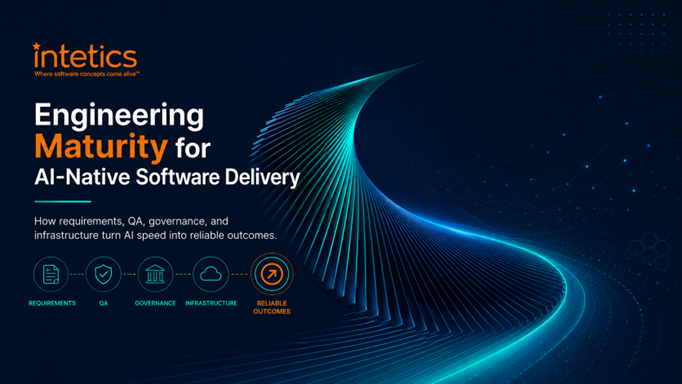
AI-native software delivery depends on more than AI tools. Sustainable results require structured requirements, accessible context, continuous QA, isolated infrastructure, review discipline, and human accountability.
Why AI-Native Delivery Matters for Business Leaders
For businesses, AI-native software delivery is not simply another engineering upgrade. It changes the economics of product development by shortening the path from business intent to tested software, which gives organizations more room to validate ideas, respond to users, and scale with less delivery friction.
This matters for founders, CEOs, product owners, and business-side executives because software delivery speed increasingly shapes market response. The advantage is not just writing code faster. It is reducing the time between product insight, technical execution, user feedback, and the next business decision.
Companies that combine strong engineering maturity with AI-native delivery can gain a structural advantage in speed, iteration capacity, and operational scalability. In that sense, AI-native delivery is not only an engineering capability. It becomes part of business agility.
A Practical Maturity View of AI-Native Software Delivery
| Stage | Name | What It Means |
|---|---|---|
| 1 | AI Tool Adoption | Teams use coding assistants and task-specific AI helpers individually. |
| 2 | AI-Assisted Workflow | AI supports requirements, coding, testing, documentation, and DevOps. |
| 3 | Governed AI Delivery | Specifications, QA, CI/CD, review, and handoffs include AI-specific controls. |
| 4 | AI-Native Operating Model | AI-assisted work is traceable, verified, scalable, and tied to business outcomes. |
The difference between these stages lies not in AI alone. It is the maturity of the delivery system around it. As AI increases the speed and volume of work, the engineering discipline becomes more valuable for companies that need reliable, scalable delivery.
Context Determines AI Value
The strongest AI-assisted delivery systems begin with usable context. Requirements, domain knowledge, architecture records, prior decisions, codebase information, test history, and operational lessons all influence what AI can safely do.
A model working from a vague ticket must infer intent. A model working from a structured requirement, known constraints, and relevant project knowledge has a narrower and safer operating space. That is why requirements become more valuable in AI-native delivery: they are not static documents, but execution artifacts that guide implementation, testing, documentation, and review.
Enterprise knowledge assistants can support this direction by acting as corporate memory during planning and delivery. Their value is not just retrieval. It is helping teams carry trusted context forward into execution.
From Experimental AI Use to Enterprise-Ready Delivery
| Approach | Best for | Main Risk | Enterprise Value |
|---|---|---|---|
| Vibe Coding | Exploration, prototypes, small fixes | Low traceability and inconsistent output | Useful, but limited |
| Spec-Driven Development | Structured features, regulated systems, scalable delivery | Requires stronger requirements discipline | Strong |
| AI-Native Delivery | Full SDLC acceleration across planning, coding, QA, DevOps, and maintenance | Requires governance, infrastructure, and role maturity | Highest |
Vibe coding can be useful for experimentation, prototypes, or narrow fixes, but it does not provide the traceability enterprise software usually needs. Spec-Driven Development is stronger because it makes the specification the source of truth. AI-native delivery goes further by connecting planning, coding, QA, DevOps, maintenance, and governance into one controlled lifecycle.
Governance Starts With Separated Responsibility
When AI becomes more active in delivery, the workflow needs clearer separation between reasoning, execution, and verification. A practical model for parallel AI-assisted development separates the work into Navigator, Driver, and Reviewer roles. This mirrors mature human engineering practice while reducing the risk of one AI system generating work and validating its own assumptions.
Navigator → Driver → Reviewer Workflow
| Role | Responsibility | Output |
|---|---|---|
| Navigator | Defines scope, architecture, risks, constraints, and Definition of Done. | Solution outline, constraints, risks, review criteria. |
| Driver | Implements the change, runs builds and tests, and prepares a patch. | Code changes, test results, patch notes. |
| Reviewer | Checks edge cases, security assumptions, rollback readiness, and alignment with the specification. | Review findings, required fixes, approval conditions. |
| Human Approval | Approves the change based on evidence rather than polished output alone. | Final decision to merge, revise, or reject. |
Simplified flow: Navigator -> Driver -> Reviewer -> Human Approval
The Navigator defines the scope, architecture, risks, constraints, and Definition of Done. The Driver executes the change and produces evidence. The Reviewer verifies the work independently, and human approval remains the final gate.
This structure matters because generated work can look complete while still missing business intent or violating architectural boundaries. Independent review keeps engineering judgment visible.
Artifacts Make AI-Assisted Work Reviewable
AI collaboration becomes difficult to govern when it is hidden inside long chat histories. Small, explicit handoff artifacts make AI-assisted work easier to inspect, reproduce, and approve. They also make the delivery trail more useful for regulated environments, client reporting, and internal quality management.
AI-Assisted Handoff Artifacts
| Artifact | Purpose | Why It Matters |
|---|---|---|
| Task Brief | Defines the goal, scope, constraints, Definition of Done, verification steps, and known risks. | Prevents vague delegation and gives AI a bounded task. |
| Patch Pack | Summarizes changed files, commands executed, tests run, and unresolved uncertainties. | Makes AI-generated work easier to inspect and reproduce. |
| Review Checklist | Turns feedback into concrete checks, such as verifying an edge case, adding a test, or confirming rollback. | Keeps review specific, testable, and accountable. |
Together, these artifacts create a visible thread from requirement to implementation to verification. That thread becomes increasingly important when AI-generated work enters production systems or client-facing software.
Quality and Infrastructure Are Part of Readiness
AI-assisted development increases the pace and volume of change, so QA needs to move earlier in the lifecycle. Testing agents can generate cases from requirements or code changes, run them in sandbox environments, and help detect edge cases before human reviewers see a pull request. The human QA role becomes more strategic: selecting meaningful tests, interpreting risk, and challenging generated output.
Infrastructure must also support parallel work. An AI agent that creates patches, runs tests, reproduces defects, or prepares pull requests needs a safe place to work. In practice, AI-native delivery requires isolated environments, observable pipelines, permission boundaries, and reliable rollback paths.
What Leaders Should Evaluate
Before scaling AI-native delivery, leaders should examine whether requirements are sufficiently structured to guide AI-assisted implementation, whether organizational knowledge is accessible, whether QA and review can handle increased output, and whether infrastructure can support parallel execution. They should also ask whether engineers are trained to verify the work generated and to explain why accepted changes are safe.
AI-native delivery is a maturity test. Organizations with strong delivery foundations can use AI to accelerate planning, coding, testing, and operations while preserving control. Organizations without those foundations may create more activity without a proportional improvement in reliability, maintainability, or business value.
They should also evaluate whether teams can properly verify AI-generated output and explain why approved changes can be trusted. Organizations that are ISO/IEC 42001 certified can strengthen AI governance through a structured AI management system that helps manage risks and opportunities while improving traceability, transparency, and reliability.
The opportunity is not only faster software development. It is a more disciplined delivery model in which AI supports human engineering judgment, and every accelerated step remains connected to intent, evidence, and accountability.
Explore the full report:
The State of AI-Native Software Engineering: 2025 Industry Analysis
Learn how AI is reshaping planning, coding, QA, DevOps, toolchains, methodologies, and engineering culture across the SDLC.
FAQs
AI-native software engineering is a delivery model where AI supports the full software development lifecycle, including planning, requirements, coding, testing, DevOps, maintenance, and governance. It goes beyond individual coding assistants by embedding AI into how software work is planned, executed, reviewed, and delivered.
Engineering maturity matters because AI increases the speed and volume of software activity. Without clear requirements, accessible context, strong QA, reliable infrastructure, and disciplined review, faster output can create more rework and risk.
Vibe coding is an informal way of using AI for exploration, prototypes, or small fixes. It can be fast, but it often lacks traceability. Spec-Driven Development uses a structured specification as the source of truth, allowing AI to generate code, tests, and documentation within clearer boundaries.
AI shifts part of the engineer’s work from writing every line of code toward defining intent, setting constraints, reviewing generated output, and verifying outcomes. Engineers remain accountable for accepted code and must be able to explain why an AI-assisted change is correct, safe, and maintainable.
Companies should improve requirements quality, organize internal knowledge, strengthen QA and review practices, prepare isolated development environments, modernize CI/CD pipelines, and train engineers to verify AI-generated output. AI adoption should be treated as a delivery maturity initiative, not only a tooling decision.